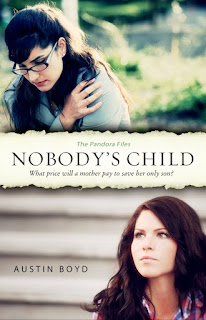
Welcome to the inaugural edition of my book review feature! The following is my review of
Nobody's Child by Austin Boyd.
The reason this book piqued my interest was that it dealt with an issue of reproductive health that I don't often deal with, from a viewpoint that differs from my own. It is written with the blessing and support of the
Center for Bioethics & Human Dignity, an organization whose mission is as follows:
The Center for Bioethics & Human Dignity (CBHD) is a Christian bioethics research center ofTrinity International University that explores the nexus of biomedicine, biotechnology, and our common humanity. CBHD fosters a distinctly Christian conception of bioethics that is both academically rigorous and broadly accessible.
So. Clearly this book is going to be a challenge for me on an ideological level. However, I do have to say right off the bat that it was beautifully written and quite thoughtful. I expected to be hit over the head with the preachy Christian stuff, but the characters were rather understated in their faith and seemed to view it as a personal matter. There was even one self-identified non-Christian who was a good character, essential to the eventual triumph of (spoiler alert!) good over evil. Don't get me wrong, there was a lot of judgement flying around, but none of it seemed directed at the reader. I can get behind that.
The story is about a young woman named Laura Ann whose father dies in the opening chapters, and who feels she must keep the family farm intact on her own, protecting it against the (ridiculously, stereotypically) evil Uncle Jack (who beats his wife, in case you were wondering if he was the bad guy) and the uncaring money-lenders down at the bank. She donates a bunch of eggs to pay her father's medical bills, and then one of the women who used her eggs to get pregnant, Sophia, shows up on her doorstep to thank her, gets stuck there because of a flash flood, becomes Laura Ann's BFF, then (spoiler alert! But not really) dies. Oh no, what about the bebeh!
This is a novel that tries very hard to be less about what happens, and more about the ideas. A lot of it involves the set up of Laura Ann trying to keep her egg donation a secret, and musings about the morality of several different aspects of her life. Sophia doesn't show up until about halfway through the book, and the big-city news reporter cousin who has a big part in finally defeating Uncle Jack only gets about two chapters of play. Maybe because she's not into God. Although of course, as a single lady, Godless and independent, there's the obligatory scene (on Laura Ann's wedding day, no less) where she confesses how jealous she is of her happily-hetero-matched cousin and her simple country life. Sure.
Side note: Did you know there is such a thing as a book trailer? I didn't! Watch
the one for this book and cringe heavily. How could this make you want to read it?
Ok so it sounds like I kinda liked the book, right? Well, I kinda did. I didn't agree with the author's analysis, and there were a lot of cultural quirks I had a hard time getting around (I guess people in Appalachia call their dads "Daddy" well into adulthood), but overall I thought it was a nice enough story and I was glad to see so many strong female characters (I can think of at least four in the book that might possibly be considered feminist). But there are three things that are stopping me from actually recommending this novel.
1.
The attitude towards egg donation: I blogged a little bit about this
here. Basically, I just could not get around the huge and incomprehensible (to me) plot point of how ashamed Laura Ann - and everyone else - was of her egg donation. Even the supportive people in her life, when they found out, were unhappy with her decision, or felt it was "the wrong decision for the right reasons". I just wanted to reach into the book, grab these characters and ask them what they thought would happen to the eggs if Laura Ann didn't donate them (spoiler alert: the toilet!). I mean really, people. I understand a little bit more where they're coming from (though I still don't agree) with regards to creating a baby from these donations, but in the end I feel like if a woman wants to sell her eggs - that she isn't using anyway!! - and someone is willing to buy them; well, what's the problem? No one shames Laura Ann for selling the wooden stools she makes in her workshop.
It doesn't surprise me that, given this attitude, donating eggs is often compared, explicitly and implicitly by various characters, to sex work. I believe the author and I are on different sides of these two issues for the same reasons. I also loved (*eyeroll*) the fact that Sophia had (of course!) been a sex worker (in a whole speech about her past that totally glosses over the reasons Latina women enter the sex trade - willingly or not - with nonsense about all the fancy clothes she was able to buy herself), and that the chlamydia she contracted eventually led, in part, to her death. Thanks for the really subtle lesson about women selling themselves, author.
In fact, the whole somewhat subtle messaging of the whole book sort of unraveled near the end, when Sophia dies (and we learn about the dangers of unprotected sex/sex work), a nurse testifies at the trial about how she used to work at the IVF clinic then left because she started to feel that the whole thing was morally distasteful (where have I heard that narrative before oh hello Abby Johnson...), and the introduction of the absolutely odious character of the judge, who is not only employed to explicitly state the moral of the story at the end of the book (seriously?), but who stops a trial in progress to give the following totally irrelevant personal view of other people's choices:
"Every day I see this ad for a genetics company out in Utah. It sickens me, to tell you the truth. They offer paternity testing, as if a woman needs a test to tell her who the father of her baby is. But I guess that's where our country is headed. Men and women sleeping around so much they don't know who the baby's daddy is."
Seriously.
2. The courtroom scenes: Okay, so clearly the author did a lot of research about egg donation and IVF, and that comes through in the book. However the courtroom scenes are so ridiculous as to be distracting, and I know nothing about American law. But I can tell you that a judge who engages in this many ethics violations is going to be removed from the case at the very least. I find it incredibly ironic that he is apparently supposed to be the unbiased voice of reason at the end of the novel - and that when he is summing up the whole adventure, it is while he is sitting in his chambers, with the defendant, talking about the case that just ended. Not OK! Really there were way too many problems with the legal stuff for me to go into here, but it made it very difficult to get through those chapters.
3. The Ian character: Ian is the love interest for Laura Ann, in a really boring romantic subplot that involves no surprises whatsoever. What bothers me about Ian - besides the fact that he is needed at all; Laura Ann is always doing the damsel-in-distress bit for him but I'm pretty sure she'd be okay without him - is that he is quite clearly emotionally abusive, and that doesn't seem to matter to anyone, least of all the author. It's as if there can only be one kind of emotional abuse - the kind where Uncle Jack doesn't let his wife go out, and he says mean things to her. Which is legitimately bad stuff, but its existence doesn't discount the fact that emotional abuse can also mean, oh I don't know, emotional blackmail like implying you will dump someone if they don't tell you their personal medical history. Or, you know, implicitly (but obviously) blaming your partner when people in town talk about her being a whore. Or being a violent asshole who punches people for spreading that rumour. All of which Ian does. Because he is an abusive asshole. Who Laura Ann likes to dress up in her dad's (sorry, Daddy's) overalls and snuggle chastely.
Yeah that whole thing for me was pretty bad.
I guess, in conclusion, I could almost recommend this book as a thoughtful take on the intersection of modern reproductive technology with "traditional" religious values, regardless of where you fall on the religion side of things. But I can't in good faith recommend it to everyone because it is potentially triggering in its endorsement of Ian's abusive behaviour. If you feel that you can get around this, please do give the book a read because if nothing else, it's always a pleasant surprise to find well-written "Christian fiction". But if it all seems a bit ridiculous to you, I would recommend just having another hearty chuckle over the trailer and then going on your merry way.